We Didn’t Create the Chaos — But We Are Responsible for What We Do With It
I keep hearing the same themes in different conversations lately. Politics are louder and more fractured. Money feels tighter and more abstract at the same time. Institutions are less trustworthy. Information is endless and contradictory. There’s a sense of instability underlying everyday life, like standing in moving water — never quite on solid ground.
One of my main frustrations is that most of these systems were created by ordinary humans, with the intention of making life better — not for what they have evolved into. The economic systems, global politics, social media, financial markets, election cycles, and the way everything now constantly competes for our attention were never designed for the scale, speed, or distortions we are living inside today.
The average person didn’t create the chaos, but we are participating in it. This is not a statement of blame, it’s a statement of agency.
Across spiritual, philosophical, and psychological traditions, there is a recurring understanding that reality follows patterns. Not moral rules in the sense of right and wrong, but functional dynamics — cause and effect relationships that operate whether we believe in them or not. In modern spiritual language, these are often referred to as the Universal Laws.
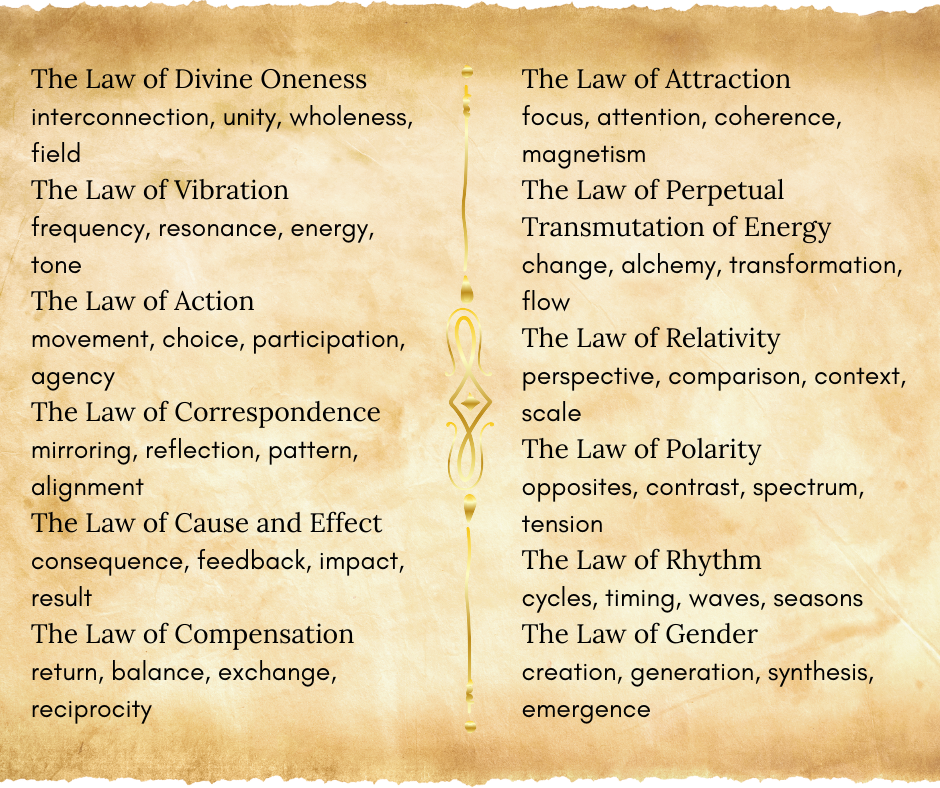
You do not have to treat these as mystical or cosmic to find them useful. You can read them simply as descriptions of how systems behave — internal systems, social systems, economic systems, political systems, relational systems. Patterns of movement. Feedback loops. Energy in motion. Ways reality tends to organise itself when enough moving parts interact over time. If you bring spiritual belief into the picture, it adds another layer of meaning, but even without that lens, these dynamics are still observable and operational.
When I look at what’s happening globally, it doesn’t feel random. It feels pulled toward extremes instead of held in balance. Reactive. Energetically charged. It feels like what happens when systems are out of balance and running at scale.
Here is the uncomfortable but strangely liberating part. Systems do not destabilise because of a few powerful people at the top. They destabilise because millions of ordinary people become overwhelmed, disconnected, cynical, or numb and slowly stop participating consciously. Not because they are bad or ignorant, but because they are tired, overstimulated, emotionally flooded, and living inside constant bombardment and threat narratives. When the human nervous system stays in threat long enough, it defaults to reactivity over reflection, identity over curiosity, polarity over complexity, and short-term relief over long-term coherence.
This shows up everywhere — in outrage cycles, tribal thinking, financial impulsivity or avoidance, ideological rigidity, scapegoating, and learned helplessness. Not because people are stupid or malicious, but because unregulated systems produce unregulated behaviour. This isn’t a political statement. It’s a systems statement. It’s the Universal Laws playing out in real time through human psychology and collective behaviour.
“The quality of a system is shaped by the quality of the awareness of the people participating in it.” S. L. Foxmere
So what does responsibility actually mean in this context? Not fixing the world. Not internalising global problems. Not manifesting a better government or a kinder economic system through positive thinking. Responsibility here means something much simpler, and much harder, at the same time. It means noticing where you place your attention. Noticing what you amplify emotionally. Noticing what you fund financially. Noticing how you consume information. Noticing how you participate in conversations. Noticing when you are regulated and when you are reactive.
Every system is made of micro-choices. What we click. What we share. What we buy. What we tolerate. What we ignore. What we reinforce. This is the Law of Action, the Law of Cause and Effect, and the Law of Compensation as lived reality. We are constantly shaping the systems we live inside, even when we feel powerless within them.
Stability is not something we wait for. It is something we generate locally — in our bodies, our relationships, our communities, and our inner coherence. It shows up in our economic behaviour and in our political participation. We do not stabilise the world by controlling it. We stabilise it by becoming more coherent inside it. Maybe this is what ending chaos actually looks like — not a grand solution, but millions of small acts of regulated agency inside systems that thrive on unconscious participation. Not heroic. Not dramatic. Just quietly adult.
Each of us making micro-adjustments to our personal systems does make a difference. It will be felt in our own lives and in the communities around us. Not as a slogan or a performance, but as a way of living that takes responsibility for what we are actually contributing to the world we are moving through.
And if any of this feels heavy because life itself feels unlivable right now — or because you’re carrying anger, despair, or hopelessness that feels bigger than you — it’s okay to reach for real support. Coherence also includes knowing when you don’t have to do this alone.
Leave a Reply