2026 Be a Good Roommate
I missed Earth Day this year. Not intentionally. Life simply moved the way life does sometimes, and by the time I realized it, the day had already passed. But the conversation itself is a passion of mine. Today I want to talk about data centers, digital life, and how disconnected most of us have become from the physical reality underneath the convenience we interact with every day.
For the past few years I’ve done an essay called “Be a Good Roommate” for Earth Day.
It’s my daily practice and my belief that this is really what living on this planet comes down to: living consciously. Trying to live in a way that reduces unnecessary waste, keeps more things out of landfills, and remembers that convenience always has a footprint somewhere, even when we cannot immediately see it.
Not perfection. Not guilt. Not pretending many of us are going to suddenly unplug from modern life and go live in a cabin somewhere without electricity or internet access. If that’s you and you ended up reading this article on Substack – Cool. I see you. 🙏🏻
Our lives are deeply intertwined with technology now. Banking, communication, GPS, shopping, medical systems, work, entertainment, memories, business infrastructure, even this piece of writing all rely on systems most of us never actually see.
But I think we’ve reached a point where convenience has become so seamless that we rarely stop to think about what supports it. “The cloud” sounds soft and abstract, almost magical. Weightless. Harmless.
But the cloud is physical.
It’s buildings.
Servers.
Cooling systems.
Electricity.
Water.
Land.
Constant energy demand.
Every search, every uploaded photo, every streamed video, every AI query, every duplicate backup, every autoplay reel, every forgotten screenshot sitting in storage somewhere exists on physical systems that require enormous resources to maintain.
To be clear, I’m not saying data centers are bad. They are infrastructure. Modern society depends on them.
The real issue is scale.
We have built an entire culture around the assumption that storage is infinite, access is instant, and convenience has no real cost attached to it. We keep everything. Thousands upon thousands of photos. Endless duplicates. Old files we never touch again. Automatic backups of automatic backups. Constant streaming running in the background like digital wallpaper.
Before cloud storage existed, we still kept memories. We still documented our lives. We still worked, communicated, created, and functioned perfectly well. There were limits, though, and limits naturally made people more intentional.
Now there are very few visible limits at all. And when human beings believe something is endless, we consume it differently. Modern life has become extraordinarily good at hiding the systems underneath convenience.
You flip on a light switch and rarely think about the grid. You upload a file and rarely think about the server farm. You ask AI a question and rarely think about the computational load happening somewhere else. You order something online and rarely think about resourcing, manufacturing, warehouses, transportation systems, packaging, fuel, and logistics networks quietly moving behind the scenes. Working in the cloud. Using data centers to make it all happen.
Convenience creates distance from consequence.
I don’t think the answer is rejecting technology or pretending digital life isn’t here to stay.
I do think the answer involves becoming more conscious participants in the systems we rely on.
Maybe we clean out cloud storage instead of treating it like an infinite junk drawer. Maybe we store long-term archives locally again. Maybe we stop assuming every moment needs to live online forever. Maybe we keep our devices a little longer before upgrading. Maybe we ask harder questions about how these systems are powered, cooled, built, and regulated. Maybe we start valuing sustainability and efficiency as much as speed and convenience.
Because I don’t believe the future is less technology. I think the future has to become wiser technology. And wiser humans using it.
To me, being a good roommate means recognizing that how we live affects the shared space around us. It means understanding that even invisible systems still have a footprint. It means remembering that the Earth is not simply a resource machine built to absorb endless consumption without consequence.
It’s home.
Our shared home.
And maybe part of growing up as a species is finally learning how to live here with a little more awareness than we have so far.
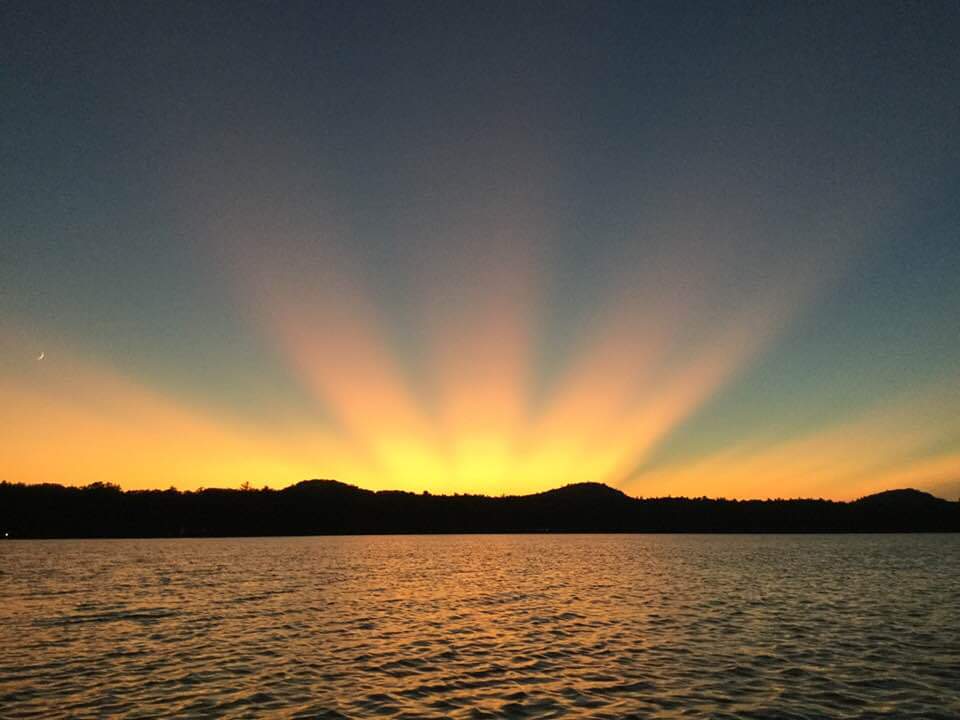
sunrise on bass lake | pentwater, mi. | sept. 2025
Ways to Lighten the Load Without Leaving Modern Life
This doesn’t have to be all-or-nothing.
I’m not suggesting we throw our phones into the woods, cancel the internet, or pretend modern infrastructure doesn’t matter. Most of us cannot function fully outside of digital systems anymore even if we wanted to.
But there are ways to participate more consciously.
As a Gen Xer, I remember early digital life before the cloud became the default answer for everything. We used floppy disks, CDs, external drives, thumb drives, printed photographs, file folders, and physical archives. Storage had limits, and because it had limits, we tended to be more intentional about what we kept.
Now storage feels endless, so we keep almost everything.
Maybe it’s worth revisiting some of those older habits.
Maybe long-term photos and family archives get moved onto external drives instead of living permanently in cloud storage. Maybe we clean out duplicate photos and files once in a while. Maybe we stop auto-uploading every single image and video we take. Maybe we become more selective about what actually deserves permanent storage and what was simply a passing moment.
Maybe we remember that streaming endlessly in the background, replacing devices constantly, and storing massive amounts of unused digital clutter still has a physical impact somewhere even if we never personally see it.
And maybe part of conscious modern living is simply reconnecting ourselves to the reality underneath convenience.
None of this has to come from fear or guilt. It’s simply awareness. A willingness to remember that convenience still lives on top of physical reality somewhere.
Because the cloud is not actually floating somewhere above us.
It lives here too.
Leave a Reply