The Journal That Talks Back
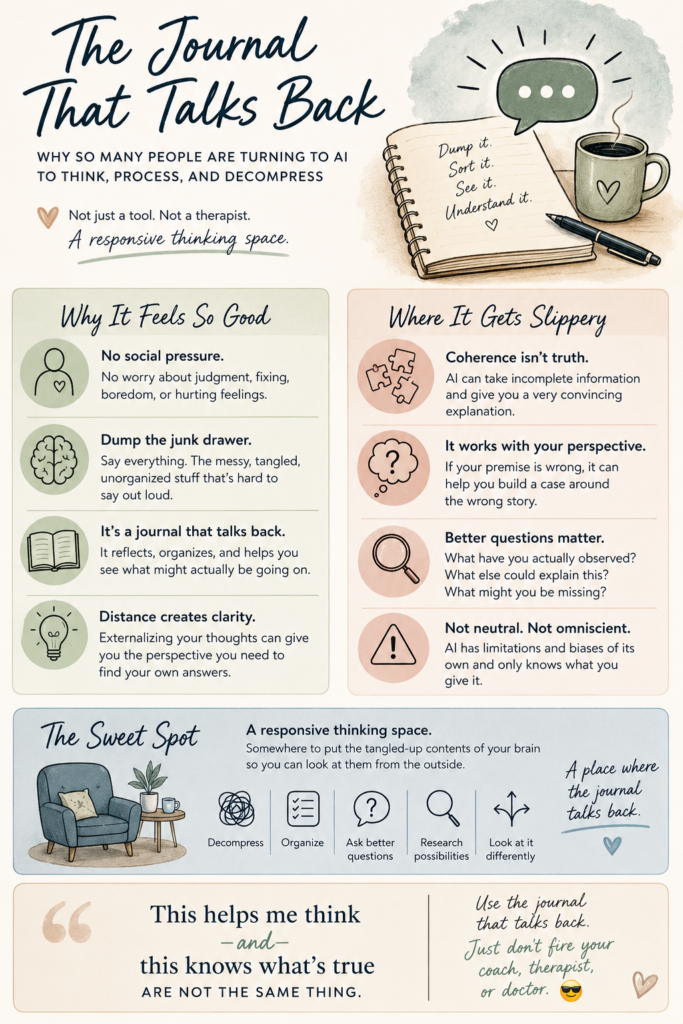 I’ve had two conversations recently about how useful AI is. The first was with a fellow coach/therapist and how using it as an administrative assistant frees up so much time, but also gives us a space to lay out and organize our creative thoughts. The second was with a friend who uses it similarly, but also as a think tank/brain dump when she is overwhelmed.
Of course I took myself to my ChatGPT app and brain dumped my observations and thoughts regarding why. And I asked for its deductions. This is a compilation of my observations and AI’s deductions.
One of the things that kept coming up for me is that there is very little social pressure when you’re talking to AI. Even when you’re talking to someone you love and trust, you’re still talking to another human being. Somewhere in the conversation there can be an awareness of: Am I talking too much? Have I complained about this seventeen times already? Do they think I’m being ridiculous? Are they going to try to fix it? Are they going to take something I say personally? We may not consciously think any of those things, but another person’s reactions, feelings, history, and opinions are still in the room with us.
AI doesn’t have a bad day, a childhood, a difficult marriage, jealousy, defensiveness, exhaustion, or its own emotional history influencing the conversation. That doesn’t mean AI is unbiased, which I’ll come back to, but it does remove an interesting layer from the interaction. You don’t have to manage the emotional experience of the person you’re talking to while you’re trying to figure out your own.
So you can basically dump your entire junk drawer of thoughts, emotions, observations, and experiences onto the table and say, Here. Help me sort through this.
We’ve always had ways of doing that. We journal. We pray. We talk to ourselves in the car. We call a friend. We talk to the dog. But AI adds something a little different to the equation.
It’s a journal that talks back.
And I think that’s a big part of why people are finding it so useful. Sometimes you don’t need someone to solve your problem. You have six different things tangled together in your head and need somewhere to put them. Having something reflect back, “Okay, I think there are actually three separate things happening here,” can give you enough distance to see your thoughts and start to process. The value isn’t necessarily that AI has given you an answer. Sometimes it has simply helped you organize your own thoughts well enough to find one.
But this is also where I think it gets slippery.
AI is working with the information we give it, and we are giving it information through our own perspective. If I say, “My coworker keeps undermining me because she’s threatened by me,” I’ve already given AI both the behavior and my interpretation of why it’s happening. It can take that premise and give me a beautifully coherent explanation that supports it.
And beautifully coherent does not necessarily mean true.
Maybe she is threatened by me. Maybe she isn’t. A much more useful conversation would also ask: What have you actually observed? What else could explain the same behavior? What information might you be missing? I don’t want a sounding board that simply hands my own assumptions back to me with better grammar. I want one that occasionally makes me examine them.
That’s also why I don’t think AI should be treated as completely neutral just because it doesn’t have human emotions. It has limitations and biases of its own, and it only knows what we tell it. If I leave out an important part of the story, misunderstand something myself, or give it a completely one-sided version of events, it doesn’t have some magical ability to know what actually happened.
Maybe that’s why I’m becoming less interested in the argument about whether AI is “just a tool” or whether people are starting to treat it like a therapist. I think there’s another category developing somewhere between those two things.
A responsive thinking space.
Somewhere to put the tangled-up contents of your brain so you can look at them from the outside. Somewhere to organize ideas, ask questions, research possibilities, challenge an assumption, or simply decompress without having to take care of another person’s experience while you’re doing it.
A journal that talks back.
I actually think there’s tremendous value in that. I also think we need to maintain enough critical thinking to remember the distinction between “this helps me think” and “this knows what’s true.”
Those are two very different things.
So use the journal that talks back. Just don’t fire your coach, therapist, or doctor. 
Leave a Reply